That
struts and frets his hour upon the stage,
And
then is heard no more. It is a tale
Told
by an idiot, full of sound and fury,
Signifying
nothing.
Macbeth Act 5,
scene 5
So
says Shakespeare’s Macbeth
after hearing the news that his wife
has died.
And
in his despair he strikes right at the heart
of some of the fundamental questions
of life:
What does it count for?
What is it good
for?
What, if anything, is its
value?
Is it all just
destined for destruction?
Where do we go, if anywhere,
when we die?
What does
resurrection mean anyway?
And what, when it comes down
to it, is the meaning of life?
Douglas
Adams once suggested that the answer
to the ultimate question of life, the
universe, and everything, might be ‘42’;
but as one who is now 43, I’m not
quite sure that nailed it,
which is almost certainly his point.
But
is it really the case, as the teacher of Ecclesiastes puts it,
that all is ‘meaningless, utterly
meaningless’? (Ecc. 12.8)
Was Thomas Hobbs right in his famous
description of life
as
‘nasty, brutish and short’?
Or was he overstating it a bit, philosophically
speaking?
Well, here we are, at the beginning of Lent,
starting
our annual journey towards the cross;
setting our faces towards Jerusalem and all
that lies waiting there for us…
Now I don’t know about you,
but
this all seems to me to have come upon us rather quickly this year.
I mean, I know that the vagaries of the
liturgical calendar
play
seasonal havoc with the dating of Easter,
and
that our Orthodox cousins have a bit more time than we do,
but in our tradition, the gap this year
between
Christmas and Easter seems very short.
The span between Jesus’ birth and his death seems
impossibly brief,
and
not only because the Easter Eggs and fluffy bunnies
were
in the shops before the New Year sales were finished,
but because life itself can seem impossibly
short.
I already have a growing list of books
that
I’m never going to get round to reading,
and an even longer list of those I’m not going
to get to read twice…
And so, I ask again,
is
this really all there is?
An hour upon the stage, and then the curtain
call of eternity?
Or is there more to life?
Well I take some comfort from the fact
that
I’m not the first person to ask this…
Others, far more profound than I,
have
wrestled with the meaning of existence as well;
and as we arrive at this point in our sermon
series
on
the ‘I am’ sayings from John’s gospel
we find ourselves confronted with Jesus’ own
engagement
with
the meaning of life and eternity.
‘I am the resurrection and the life’,
says
Jesus to Martha, in the face of her brother’s untimely death.
And in saying this, he is speaking not only
into her own grief,
but
also into a wider philosophical debate
around
the meaning of life in the face of death.
It can seem strange for us,
because
we’re so used to taking it as a given,
but the Jews at the time of Jesus
were
far from unanimous in their beliefs about the afterlife.
Many very religious Jews would have been
entirely convinced
that
there was no such thing as an afterlife,
let
alone a future resurrection.
And for those of us who are accustomed to the
Christian tradition,
where
we’re often told that the main reason for believing in Jesus
is
so that we get to go to heaven when we die,
the idea of a belief in God that is divorced
from a belief in the afterlife
can
come as something of a shock.
But actually, the idea of a future
resurrection,
of
some kind of life beyond death,
only enters the Jewish scriptural tradition
really
quite late in the day.
It’s only in those Jewish books
written
in the couple of hundred years or so before the time of Jesus
that we start to find the development
of
the concept of post-mortem immortality.
So, for example, the book of Daniel, written in
the second century BC,
includes
the claim that
‘Many
of those who sleep in the dust of the earth shall awake,
some
to everlasting life, and some to shame and everlasting contempt.’
(Daniel
12:2)
And this provides us with the only clear
statement of belief
in
the resurrection of the dead
in
the entire Old Testament.
In fact, the evidence from earlier texts that
Daniel
is
that the idea of resurrection is rejected entirely.
For example, the book Job specifically states
that
“mortals
lie down and do not rise again.”
(14.12)
while a few other places use the language of
resurrection metaphorically,
as
an image for the restoration of the nation of Israel,
as we find for example in Ezekiel’s vision
of
the Valley of Dry Bones (Ezek 37).
So the reference to everlasting life in the
book of Daniel
is
something of an anomaly,
and in its context it is probably best heard
not
as a prediction of life beyond death for the righteous
but rather as a quality of life achieved by the
wise
that
endures into eternity.
It’s only really when we get to the Jewish
texts
that
come from what’s known as the inter-testamental period;
the
150 years or so between the finishing off of the Old Testament
and
the birth of Jesus,
that
we start to get a more developed belief
in
future resurrection and judgment.
So, for example, there’s a fascinating but
little-read book
known
as 1 Enoch,
which goes into some considerable detail about
how the spirits of the dead
are
kept in different chambers as they await the day of judgment (1 Enoch 22);
and the book known as ‘The Wisdom of Solomon’,
actually
written much, much later than the time of Solomon himself,
has a view of existence beyond death
that
involves immortal spirits but not resurrected bodies (chs. 2-5).
However, many Jews at the time of Jesus
held
to the older belief that there is no meaningful existence beyond death,
only,
at best, a shadowy existence known as ‘Sheol’
(cf.
Sirach 17.27-28; 30.17; 41.4).
In the New Testament we get something of a
glimpse of this uncertainty,
with
Mark telling us that the Sadducees, who didn’t believe in the resurrection,
came
to question Jesus about it (12.18-27)
You know the old joke?
The
Sadducees don’t believe in the resurrection,
and
that’s why they’re sad, you see?
The point, though, is that we need to know
something of all this background
if
we’re going to hear Jesus correctly
when
he does speak about resurrection.
Those of us who come from the twenty first
century
are
the heirs to a lot of theology, and indeed medieval mythology,
that
comes from our tradition and informs the way we understand things,
but which would have been entirely alien
to
both Jesus and his contemporaries.
So, for example, when Jesus answers the
Sadducees,
escaping
their logical trap
about to whom a woman, betrothed to
seven brothers in turn,
would
be married to in the afterlife,
he
speaks of God’s commitment to Abraham, Isaac, and Jacob,
as something that transcends death.
But
he tells them they’re quite wrong if they think of eternity
as
some kind of place where people carry on living
much
as they do in this world.
It’s only really in the decades and centuries
following Jesus,
as
Christians reflected on the stories of his resurrection,
that any kind of comprehensive belief in the
future resurrection for individuals
started
to emerge as a consistent strand of belief,
and, as with the language we met in the book of
Daniel
is
usually tied to the idea of judgment
where the wrongs of this present age are
righted,
and
the wicked get their just desserts
while
the righteous get their pie in the sky by and by.
And so we come to Jesus’ astonishing statement
to Martha,
uttered
in the face of the death of a beloved friend and brother,
that
in him is ‘the resurrection and the life’.
A Sadducee would have said that Lazarus is
dead, gone,
and
to be mourned and remembered before God.
A Pharisee would have said that he had gone to
be with God,
to
meet either mercy or judgment.
Jesus says neither.
What he offers, instead, is a radical
revisioning
of
human existence in the face of eternity.
Resurrection, the way Jesus embodies it,
isn’t
something that happens ‘at the last day’, as Martha puts it.
This is no vision of some future point in
temporal history,
when
the graves will be opened and the dead climb out,
to
roam a re-created earth.
Resurrection in Christ isn’t the Zombie
Apocalypse.
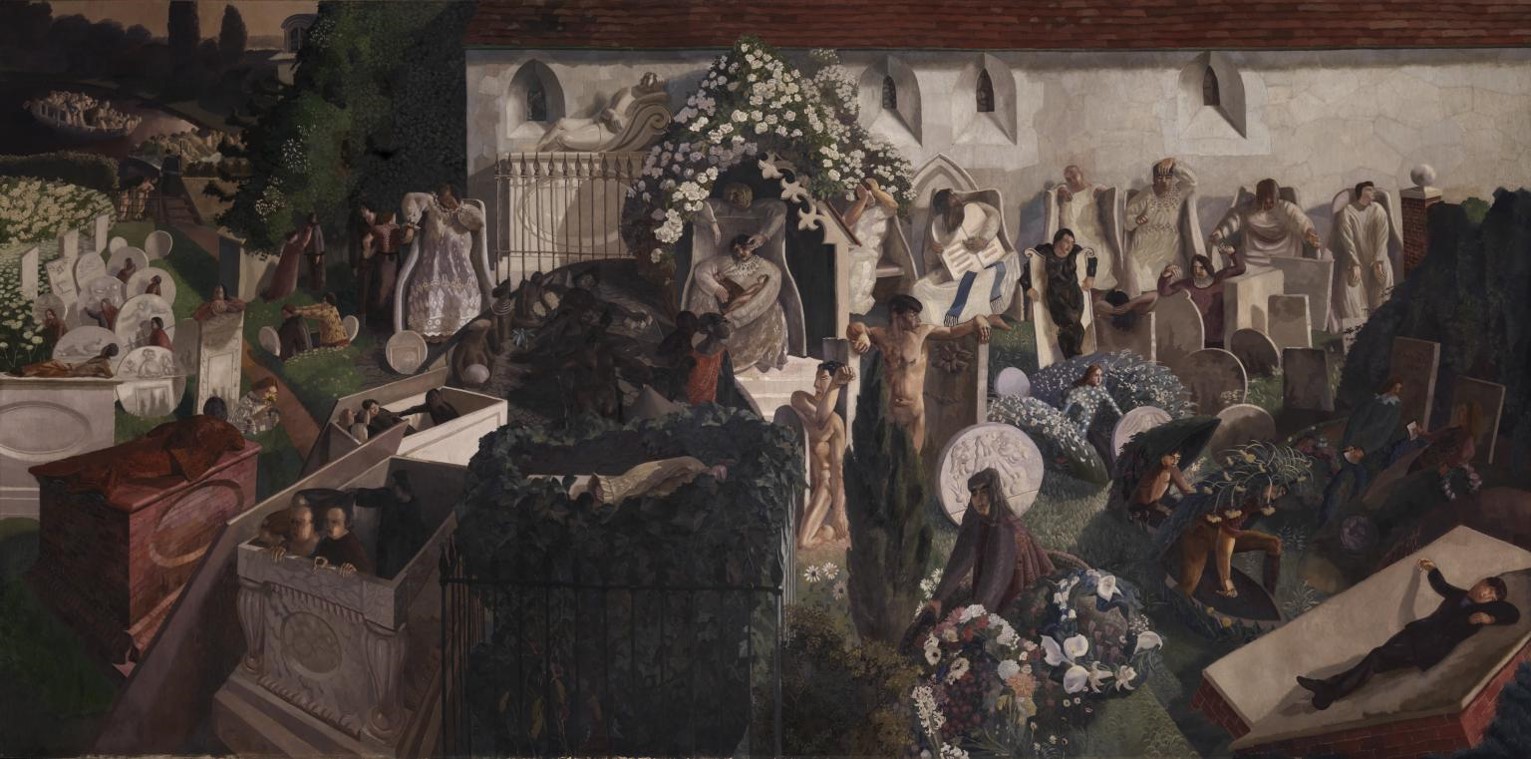
Do you know Sir Stanley Spencer’s wonderful
painting
from
the period just after the first world war,
of Resurrection in Cookham Churchyard?
Sir
Stanley Spencer, The Resurrection, Cookham 1924–7
Spencer
believed that the divine rested in all creation,
and he saw his home town of Cookham as
a paradise
in which everything was invested with
mystical significance.
So
in this painting, he makes the local churchyard
the setting for the resurrection of
the dead.
At
the top left, risen souls are transported to Heaven
in the pleasure steamers that then
ploughed the Thames.
And in fact, all the bodies rising from their
graves
are
contemporaries of Stanley,
all
very much alive at the time he painted them,
and
intended to be so.
They are his friends, and they are helping him
'resurrect'
into
a new world of enlightenment he is exploring within himself.
We could spend a long time on this painting,
but
the point Spencer is making is fairly clear:
for him, resurrection isn’t about the future,
it’s
about the present, as people move from death to life,
as
they wake up to a fullness of life
that
transcends the hell of the trenches of the great war.
And so we’re back to Jesus,
using
the language of resurrection in the face of a terrible death,
offering a vision of life that transcends the
power of death
and
defeats the ideology of hell.
Resurrection, as embodied in Jesus,
isn’t
some future vision of judgment
leading
to punishment or reward,
with the damned condemned to an eternity of
medieval horrors
and
the elect rewarded with eternal adoration and haloes.
Actually, it’s the opposite of all that.
Resurrection in Jesus
is
an eternal quality of life
that transforms the present
and
opens the way to a hopeful future.
Jesus is ‘the way, the truth and the life’,
he
is ‘the resurrection and the life’,
he is ‘the life’, and he offers the way to
life,
by
bringing resurrection to bear on the present.
Those who live in fear of the future are
released,
and
those who long for a better world are empowered.
One of my favourite pictures of the afterlife
is the ‘Last Judgment’
by
Hieronymus Bosch,
It’s a beautiful and terrifying painting,
depicting
the gruesome horrors that await the damned
and
the glories that await the righteous.
The medieval worldview depicted in this
painting
is
massively influential in the way we still think of resurrection
right
down to the present day.
And yet, if you ask me to choose,
I
think Spencer is much closer to what Jesus was getting at
than
Bosch ever was.
The life eternal which finds its embodiment in
Jesus
is
exactly what he, and it, says it is:
it
is ‘life eternal’.
In the person of Jesus
is
found a transformed quality of existence
where life itself takes on meaning
in
the face of eternity.
Life’s brief shadow acquires eternal value.
In Christ, who is the resurrection and the
life,
life
acquires an affinity to eternity.
This is not a promise of future resurrection,
it
is rather the defeat of death in the here-and-now.
Just as Spencer offered a vision of
resurrection
in
the face of the horrors of the great war,
so Jesus offers a way through the horror of
death,
to
a new world of hope and life.
And it is a vision of life that makes all the
difference.
Those who would follow Jesus
are
not called to sit and wait for future salvation.
Rather, they are transformed in the present
by
the renewing of their minds (Rom 12.2),
and are called to participate in the
transformation of creation,
as
all things are redeemed into God’s eternal embrace.
The statement that Jesus ‘is the resurrection
and the life’
draws
eternity into the present;
and endues the present with the hope of
eternity.
Those who inhabit this life eternal
are
called to live life in the love of God and out of love for others.
It is in the focusing of life onto the other,
that
the self-absorption that dominates our existence is redeemed.
Think about Adam and Eve for a moment…
There is no indication in the Genesis creation
myth
that
Adam and Eve would have escaped eventual physical death,
and
similarly no indication that death is their punishment.
Rather, the result of their idolatry,
of
their placing themselves at the centre of their world
and
their displacing of God from his rightful place in the cosmos,
was that death became an enemy to be feared
and
a foe to be fought.
The life-eternal,
that
is presented as the original gift to Adam and Eve,
and
which the story of their fall from grace so vividly mourns,
is
seen to be recovered in Christ, the new Adam.
Jesus brings into being a restored and renewed
humanity
where
people experience life in all its fullness.
The enmity with death that has blighted
humanity
since
consciousness of our own existence first emerged,
is resolved in the invitation to enter into the
selflessness
of
a consciousness renewed by Christ’s own self-giving sacrifice.
By this understanding, witnessing to Christ is
therefore not about
saving
people from the eternal fires of hell,
but rather about saving people from the hells
of the here and now.
Whether it is the hell of depression or
dementia
or
of suffering or homelessness or displacement,
or
any other of the unimaginable horrors
that
confront us with the brute reality of our frailty and mortality…
We are those who, in the name of Christ,
are
called to invite people into life lived in all its fullness,
into
life where death’s darkness is defeated
and
the light of life inhabits frail flesh.
We are called to bring good news to the
oppressed,
to
comfort those who mourn,
to
bind up the broken,
and
heal the sick,
and
proclaim release to those enslaved,
whether
by their own desires or by the actions of others.
For so many people,
life
is simply a death avoidance strategy
which
we are all, ultimately, destined to lose.
We construct our ideologies of health and
wealth
to
allay our fears, and deny our mortality,
embracing denial and nihilism in equal measure
as
we seek meaning in life.
We give it up for lent, and then take it back
up again for the summer,
all
the while ignoring the one who calls us
to
take up our cross and follow him to Jerusalem
to
journey through death to life eternal.
We may hope that we can do the good we can,
and
get out with grace leaving he world a better place than we found it;
but in Christ, the message of redemption is far
more comprehensive.
In Christ, each moment has eternal value.
In Christ, eternity becomes now, and now
becomes eternity.
In Christ is the resurrection and the life.
I’m going to close with some words from the
recently beatified Oscar Romero,
the
priest who campaigned against poverty, social injustice,
assassinations
and torture in his country of El Salvador.
He said,
"I
must tell you, as a Christian, I do not believe in death without resurrection.
If I am killed, I shall arise in the
Salvadoran people."
For those who are in Christ,
death
is defeated and life is eternal.
Because in Christ, is found the resurrection
and the life.