A sermon preached at
Bloomsbury Central
Baptist Church
30 September 2018
Luke 6.17-19; 8.43-46
Acts 5.12-16; 19.8-12
This week’s sermon in our anti-lectionary series,
in which we
are looking at passages and topics
that don’t
normally get addressed from the pulpit here at Bloomsbury,
takes the form of a question:
Do miracles
still happen?
From my days of setting exams for university students,
I remember
the adage of never setting a question
which could
be answered with a ‘yes’ or a ‘no’,
but on this occasion I’ve done it.
Do miracles
still happen?
What do you think,
particularly
in the light of our Bible readings for this morning?
My guess is that if you’ve got history with a different kind
of church,
you may
have heard this kind of passage preached before,
and it may be that the reason you’re at Bloomsbury,
is that we
usually stay away from them.
Let’s see how we get on.
On my way to church this morning, I walked past this sign,
which has
just gone up at Waterloo Station,
and I thought
it was a good introduction to the sermon:
Also, I was fascinated this morning
to discover
that the BBC news was publicising the results of a survey
on the belief,
or not, in miracles, amongst the UK population.
Apparently, 3 in 5 people believe in miracles...
Last week was Open Doors weekend here in London,
which if
you don’t know is when various buildings
that are
normally closed to the public open their doors,
and
some of them put on tours.
Liz and I went to the Royal College of Physicians
for a
fascinating tour of their Grade 1 1960s listed building,
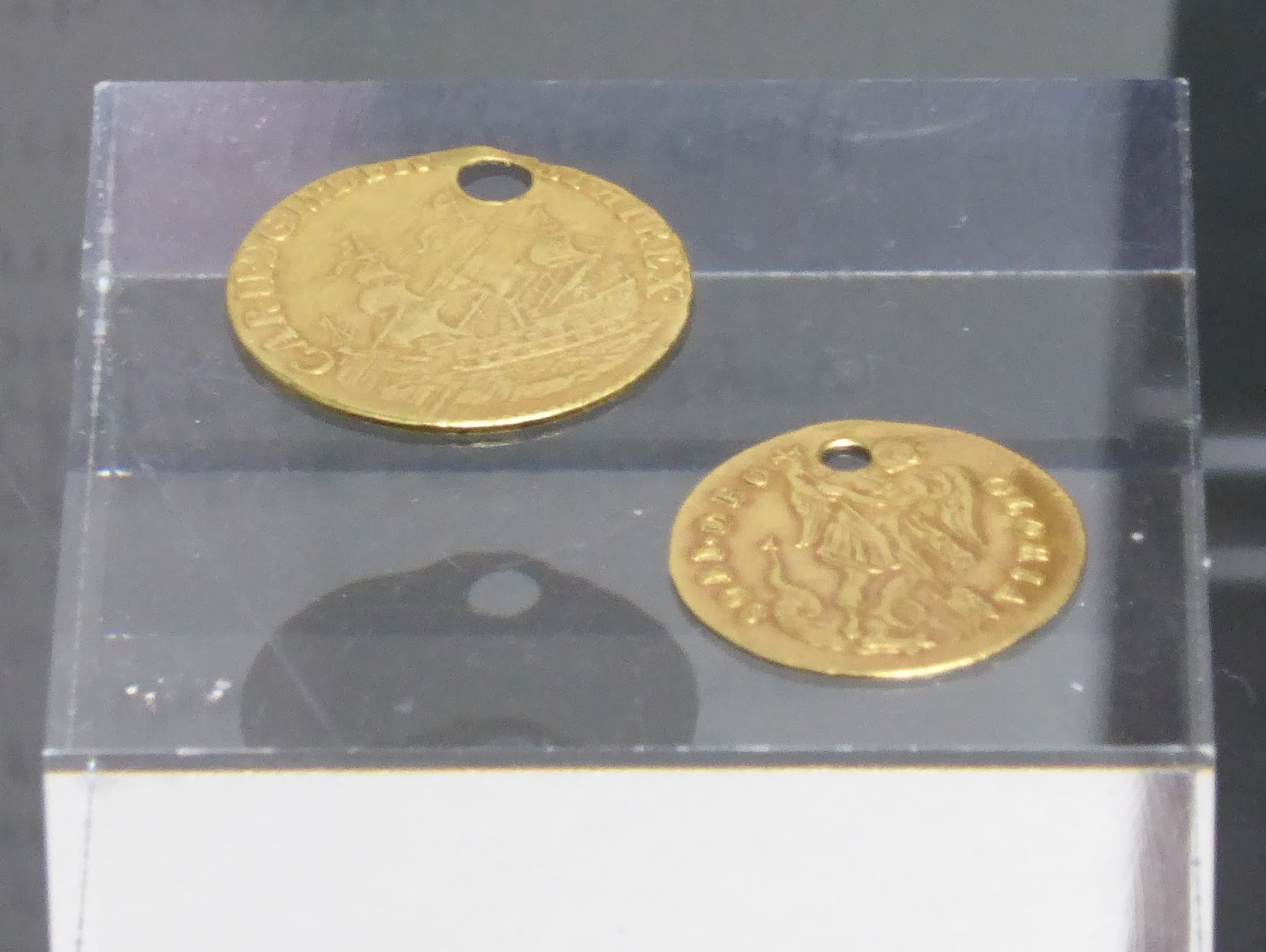
and in the exhibition there I saw these two gold coins,
and I
thought, ‘I know a good sermon illustration when I see one!’
Does anyone know what they are?
These are gold ‘touch-piece’ coins from 1660-85,
sometimes
called ‘Angels’ because they had the Archangel Michael on them.
These were used in public healing ceremonies by British
monarchs
from the 15th
century onwards.
The monarch was believed to have authority from God
to cure
what was then called ‘scrofula’, a kind of tuberculosis.
King Charles I apparently ‘cured’ over 100,000 of his
subjects
in public
ceremonies with his royal touch
and by
placing gold coins around the patient’s neck on a ribbon.
The practice finally was ended in the 18th
century by King George I
who
apparently regarded it as too superstitious,
or possibly
(according to some sources), ‘too Catholic’!
Anyway, it raises an interesting question for us,
which is
relevant for our reading for this morning.
And the question is this:
do we
believe that a hundred thousand people were cured of tuberculosis,
by the King
of England placing gold coins around their necks?
It may be that you disagree with me on this,
but from
where I’m standing,
as
a post-enlightenment scientifically literate person,
it
sounds like utter nonsense.
Of course
it didn’t happen.
People
are not healed by the touch of the king,
nor
by touching something that the king has touched.
And yet, the origin of the belief that this could, and indeed
did, happen
is found
directly in our readings for this morning,
where
people are healed by touching Jesus or his cloak,
and by
having the shadow of Peter or the handkerchief of Paul fall onto them.
So what are we to do with the related question
of whether
we believe that people were healed of their diseases
by
touching Jesus, or his cloak,
or
by Peter’s shadow, or by Paul’s handkerchief?
Again, it may be that you disagree with me on this,
but from
where I’m standing,
as
a post-enlightenment scientifically literate person,
it
sounds like utter nonsense.
Of course
it didn’t happen.
There, I’ve said it.
I don’t think it happened in the first century,
I don’t
think it happened in the seventeenth century,
and I don’t
think it happens today.
Do miracles like this still happen?
No. And I
don’t think they ever did.
Here endeth the sermon for this morning.
I said there was a danger in asking questions which invited
one word answers.
Except…
It seems to me that the question
of whether
these things happened or still happen
is possibly
the least interesting part of these
stories.
St Augustine, writing in the fourth century,
was
concerned that people got stuck on the ‘wonder’ aspect of miracles
-
the ‘against nature’ bit –
and spent
so much time speculating on whether these things actually happened
that
they missed the real point of the story.
He said,
Let us ask the miracles
themselves what they tell us about Christ,
for
they have a tongue of their own, if it can only be understood.
Because Christ is the Word of
God,
all
the acts of the Word become words to us.
The miracle which we admire on
the outside
also
has something inside which must be understood.
If we see a piece of beautiful
handwriting,
we
are not satisfied simply to note
that
the letters are formed evenly, equally and elegantly:
we also want to know the meaning
the letters convey.
In the same way a miracle is not
like a picture,
something
merely to look at and admire, and to be left at that.
It is much more like a piece of
writing
which
we must learn to read and understand.
So if we return back to the story of the King of England
curing
scrofula by handing out gold coins,
we might find that if we can get over the hurdle of
‘did these
healings really happen?’ (answer: ‘of course not’),
there is a more interesting answer to be had
in the
question of ‘why was this story told and circulated?’
And here we find ourselves in the world of power, politics,
and the
relationship between the state and the church.
The reason people of power propagated the belief
that the
monarch could heal in this way,
was because of what it said about the divine right of kings.
After all, if Jesus, and Peter, and Paul could do these
things,
then the
divinely chosen successor
to
Christ’s power and the authority of the apostles
must be
able to do them too.
And, of course, keeping the population cowed in awe and
loyalty,
by
spreading stories of the amazing divine power of the monarch,
particularly
over a feared disease that struck children and adults alike,
was a powerful tool for maintaining social order.
And the thing is, some of those people receiving gold coins
from the king
would have
got better.
Just as some of those on whom Peter’s shadow fell,
or who
received a handkerchief from Paul, would have done.
The human body has an astonishing capacity to heal itself,
and
sometimes diseases, even serious ones,
do get
better of their own accord.
And then you need to factor in what we now call the placebo
effect,
where the
administration of an inert substance
generates
a genuine physical healing effect,
as the
patient believes they are being treated.
This relationship between the mind and the body
is still
being explored by medical science,
but it does seem that a positive mindset
can
sometimes have a healing effect on the body.
By the same token, a person who lives with
immense
stress and depression for many years
may well find that it has a negative effect on their physical
health.
It’s interesting that in both our passages from Acts,
and one of
our passages from the gospels,
the narrator specifically mentions both those who are
physically sick,
and those
who are tormented by spirits (Luke 6.18; Acts 5.16; 19.12)
The link between sickness of the mind,
and
sickness of the body, is profound and real.
This is why I’m always willing to pray with people about
their illnesses.
I’ve sat with people in suffering and sickness,
and prayed
for them to receive the healing peace of Christ
by
the power of his Spirit;
and I’ve
seen them relax, find peace in their pain,
and
experience a move towards wholeness
in
both their mind and body.
It’s also why I’m always willing for us to pray for one
another
in our
sorrows and illnesses,
because a world where our attention has been turned away
from ourselves
and towards
another in love,
is a world where Christ’s healing is coming to reality in
our midst
as
selfishness is set aside, and love is made real amongst us.
We should not underestimate the power of prayer for healing
to bring
people to wellness and wholeness.
But neither should we overestimate our ability
to banish
disease in the name of Christ.
In all my experience of ministry, over nearly twenty years
now,
some of it in
more charismatic environments
where
prayer for physical healing was common,
I’ve never
seen someone incontrovertibly healed of a physical illness.
For example, I’ve never seen someone with a missing limb
have it grow back.
I’ve heard
plenty of claims made for healings in response to prayer,
but
they have always seemed to me
to
be at the tenuous end of medical proof.
At one level, I’d love to think that I could pray for
someone who is terminally ill,
or
seriously impaired by disease,
and see
them healed before my eyes.
But I just don’t see that happening.
And actually if it did, I think I’d actually have a deeper
problem,
which would
be why it should be
that some
were healed in this way and some not?
I’ve heard it said that whether someone is miraculously
healed
depends on
either the faith of the person offering the prayer for healing,
or more
insidiously on the faith of the person being prayed for.
I’m afraid I firmly reject both of these explanations.
For my
money, the reason people aren’t physically healed
against
the laws of nature,
is because
God doesn’t work in that way.
The healing he brings is not a capricious, conditional,
supernatural miracle.
Once, when I was attending a ministers’ conference,
I went to a
seminar on Healing and Wholeness.
The facilitator was great, and spoke about how God’s healing
can sometimes
be helping a person come to terms with their illness,
and move
with God towards a good death.
In this context, I shared a little of my own family’s
situation,
as my wife’s
mother was at that time dying with Alzheimer’s Disease.
I said that we were pray for her to have a ‘good death’.
A fellow minister, sat opposite me, folded his arms and said
to me,
‘Your
problem, mate, is that you don’t have enough faith.
If you’d
seen the things I’d seen, and if you had more faith,
you’d pray
for her, and she would be healed.’
Thankfully the facilitator moved us on at this point,
but later
that evening in the bar, I decided a further conversation was in order.
So I approached the man who had challenged me,
and said
that I was still angry and hurt at what he had said.
Then I asked him if he would be willing to give me permission
to punch
him on the nose, and break it.
I said that if he was, I’d feel better,
but that
because he has faith to pray for and see healing,
he could pray
and he would immediately get better.
At which point, I’d see that he was right and I was wrong,
and I’d apologise,
and he’d have convinced me.
So, I said, ‘I guess it all boils down to how strong your
faith is?’
Strangely, he just put down his pint,
and walked
out of the room, and never spoke to me again.
I think Jeffrey John, who preached at Bloomsbury recently
for the 2:23 gathering,
is quite
helpful here.
In his book, ‘The Meaning in the Miracles’, he says:
The stories of healing in the New
Testament are, ‘of course,
[demonstrations]
of Jesus’ healing power and compassion
for
the individual [who is healed],
but
that is not the main point.
Uppermost… and far more relevant
to us
-
is the miracle’s universal significance:
the overturning of social and
religious barriers;
the
abolition of taboos;
[the]
declaration of God’s love and compassion for everyone,
expressed
in the systematic inclusion
of
each class of the previously excluded or marginalised…
As we consider the meaning of …
miracles for today,
the
question [that] repeatedly poses itself [is this]:
how far has the church seen or
wanted to see
the
implications of this systemic, subversive,
highly
risky inclusivism on Jesus’ part,
[or how far has it] preferred
instead
to
create and cling to its own taboos?’
So let’s see how this kind of approach
might help
us understand the anti-lectionary readings
that we
have set ourselves for today,
and if it can help shed light on how they might speak to us
about our
own Christian discipleship.
The first thing I’d like us to notice about the two stories
from the book of Acts,
of Peter’s
shadow, and Paul’s handkerchiefs,
is that they give us a powerful example of God’s healing
power
breaking
out of the boundaries that have been set around it.
In the reading from chapter 5,
those who
are cured are people who are so ill that they cannot even walk,
and who
have to be carried out into the streets.
The effect in those days, of being so ill you couldn’t walk,
was that in
a number of key ways you were excluded from society.
Firstly, you couldn’t attend religious ceremonies and
festivals,
and so you
were excluded from the worship life of your religion.
Secondly, you couldn’t work,
and so you
were a burden on your family.
Thirdly, you faced economic exclusion
from wider
society.
And fourthly, there was a good chance that you were
considered ritually unclean,
which would
extend your exclusion to those who shared your house.
In this context, the story of people receiving the touch of
God,
in as
random and profligate a manner
as simply
having the shadow of an apostle fall on them,
becomes a powerful story about the breaking down of those
barriers
that
exclude the sick and the vulnerable
from the
presence and love of God.
Interestingly, in the ancient world,
a person’s
shadow was believed to convey something
of
the essence of the person, whether for good or for evil,
with Cicero
speaking about how a corrupt person’s shadow
could
affect those it fell over.
Stand off, my friends, nor come
within my shade,
That no pollutions your sound
hearts pervade,
So foul a stain my body doth
partake.
These days we usually work with a social model of disability,
where a
person’s impairment might be physical,
but its
disabling effect on them is determined by society.
So, for example, a person who is a wheelchair user
is only
disabled from being up on this platform with me
if we, as a
community, have not invested in a ramp
that
they can use to get up here
(we do have
one, in case you’re wondering).
And I think that we need to hear a challenge from this
passage
for us, as
the inclusive and welcoming community of Christ’s people,
to take seriously what it means
for us to
ensure that those who are impaired
are not
disabled from coming to God in worship.
We have questions to ask ourselves about how accessible we
are,
and I’ve
been interested recently to read the resources
from
an organisation called Inclusive Church,
who
highlight not only disability,
but also sexuality, ethnicity,
gender, mental health, and poverty,
as factors
that can exclude people from the worshipping community.
But also more widely,
I think
there is a call here for us to be active
in challenging those systems and structures
that
disable the sick and the vulnerable from participating fully in society.
We might, for example, need to take a long hard look
at the inhumane
roll-out of Universal Credit,
as
it forces people further into the poverty trap it claims to be alleviating;
or the rise
in zero hours contracts,
which
the Archbishop of Canterbury recently described
as
‘the reincarnation of an ancient evil’.
There are social forces and structures
that
exclude and disable, disempower and demean,
and the healing love of God in those circumstances
is needed
as much now
as it was when people were carried to Peter
for his
shadow to fall over them.
But moving on,
what are we
to make of Paul and his handkerchiefs and aprons?
My great aunt was a member of an organisation called the
Panacea Society,
a bizarre
early-twentieth-century, proto-feminist,
apocalyptic
sect, based in Bedford.
Amongst their various other activities, they offered a
healing ministry,
thought by
its members to be a ‘panacea’ a healing cure for all illness.
The cure consisted of drinking ordinary tap water
infused
with a linen square in it
that had
received the prophetess Octavia’s divine breath.
A kind of healing-handkerchief tea-bag.
These squares of linen were sent free of charge to anyone
who requested the healing,
and in
total applications were received from 130,000 people
across 90
different countries.
There is a clear parallel here between this recent movement
- the
Panacea Society still exists, and a friend of mind works for them –
and the healing ministry of Paul’s holy handkerchiefs.
Setting aside, again, the question
of whether
these healings actually occurred (answer: they didn’t),
we might notice that there is a contrast as well as a
similarity
between
Paul’s healing ministry in chapter 19,
and Peter’s
in chapter 5.
Whereas Peter’s shadow was falling on those excluded from
Jewish society,
it was
still falling on Jews, in Jerusalem.
Paul’s handkerchiefs are going out
to bring
the healing peace of Christ to the gentiles of Ephesus.
Paul makes a significant physical move in verse 9,
when he
walks out of the Synagogue after three months of teaching there,
and starts
speaking instead in the public lecture hall.
He leaves Jewish space, and moves into gentile space.
The breaking down of barriers that had begun in Peter’s
ministry
is taken to
a new level in Paul’s,
as the ethnic barrier between Jew and gentile
is once
again challenged within the narrative of the book of Acts.
Also, the distance over which the healing is given is
increasing.
Peter needed to be nearby for his shadow to fall on people,
but Paul’s
healing cloth can go far and wide.
The sick needed to be carried to Peter,
but Paul’s
ministry of healing goes to the sick wherever they may be.
It seems to me that this is a story
that speaks
powerfully of the love of God
extending
over ever greater distances,
and across
ever more challenging boundaries,
as
the early church embraced the message of universal love
extended
to all in the name of Christ.
There’s an interesting further parallel
with the
only three healing miracles in the gospels
which are
done at a distance.
The Syro-Phonician Woman’s Daughter (Mk 7.24-30; Mt
15.21-28),
the
Centurion’s Servant (Mt. 8.5-13; Lk 7.1-10),
and
the Capernaum Official’s Son (Jn 4.46-54),
are all miracles of healing that cross boundaries
- of gender,
geography, ethnicity, or social class.
The message starts to become clear,
which is
that God’s wholeness for humans
is
not restricted to a select few,
nor is it
defined by geography or gender,
nor
is it constrained by ethnicity,
nor
is it controlled by class.
Over the last two weeks, our sermons here at Bloomsbury
have
challenged us on racism and slavery,
and
on sexuality and hospitality.
We need to hear these messages, and act on them.
If the biblical stories of miraculous healing
are not to
be reduced to pointless debates over historicity,
and if we are to avoid the damaging and abusive approaches
to healing
that some
Christians fall into
when they try
to replicate these stories in a contemporary context,
we need to open ourselves up
to the
possibility that the healing love of God
is
far wider, and far more comprehensively offered,
than
specific prayers for specific individual illnesses.
The healing that is in view here,
is not so much the
healing of the individual,
as it is the
healing of society.
And the challenge is to seek the transformation
of those
structures that disable the weak and vulnerable,
that
marginalise the minority,
and
that seek to legitimate their own power,
by claiming for themselves
a healing power
that it is only God’s to dispense.
x